 With a massive 8.8 earthquake striking near Chile and sending a tsunami across the Pacific, Hawaii readies itself for what could be a devastating strike. The island state has a history of being stricken by tsunamis, some generated locally but many from far off areas.
According to the U.S. Geological Survey (USGS), 50 tsunamis have been reported in Hawaii since the early 1800’s. Of those seven caused major damage. Five of those were generated from areas outside the state.
A tsunami is a series of waves that start out as a disturbance under the sea (such as an earthquake), and then increase in intensity. The disturbance causes the waves to travel outward in all directions. In this article, you will learn more about the causes and effects of tsunamis.
The motion of a tsunami is similar to what happens when you toss a rock in a lake and ripples start to form and move about the water. The time it takes for the waves to fully form is between 5 and 90 minutes. Sometimes, the wave speed in the open ocean will average 450 miles per hour.
Tsunamis that have reached a height of more than 100 feet have been recorded. The closer the waves get to reaching shallow coastal waters, the more normal they appear. The speed also decreases. If a tsunami closes in on the coastline, other conditions arise. It may grow in height and when it reaches the shore – it can be highly destructive.
An earthquake is not the only natural occurrence to cause a tsunami. Landslides, volcanic eruptions, and even meteorites have been known to cause an earthquake. A tsunami can start hundreds or even thousands of miles away from coastal areas. Location can play an important role in the effect of a tsunami. The regions at a great risk for suffering a tsunami are found less than 50 feet above sea level and within one mile of the shoreline.
Tsunamis cause a succession of high and low water levels. These kinds of crests and troughs usually occur about 10 to 45 minutes apart.
The highest death toll from a tsunami happened on December 26, 2004, when an earthquake with a magnitude of 9 occurred under the Indian Ocean. The tsunami struck off the coast of Indonesia with a wave that affected the coastlines of nine different countries about the Indian Ocean. It was estimated in January 20, 2005 that the tsunami took the lives of at least 226,000 people. The total death toll is a number that will never be known.
Other Facts About Tsunamis
A 1964 earthquake in Alaska caused a tsunami with waves that measured between 10 and 20 feet high. The effects of the tsunami were felt along the coasts of California, Oregon, and Washington. In Alaska, more than $84 million in damage was incurred and the tsunami killed 123 people.
Since 1945, more people have lost their lives as a result of tsunamis than as a direct result of what happens with an earthquake.
Tsunamis are rare along the Atlantic coastline. However, a serious earthquake that took place on November 18, 1929 in the Grand Banks of Newfoundland. A tsunami developed and as a result, a great deal of damage and deaths took place at Placentia Bay, Newfoundland.
The most common way that a person dies during a tsunami is by drowning. Other causes of death include flooding, polluted water supplies, and damaged gas lines.
A tsunami that occurred in 1946 sent waves of 20 to 32 feet to crash into Hilo, Hawaii. The downtown part of the city flooded and in the process, 159 people were killed.
An estimate 10,000 people died in Hong Kong when a typhoon accompanied by a tsunami took place in 1906.
The Tsunami Warning Centers in Honolulu, Hawaii, and Palmer, Alaska, keep an eye on the disturbances that can lead to tsunamis. When a tsunami is detected – it is tracked. Tsunami warnings are then issued for areas in danger.
The worst tsunami to strike Hawaii in modern history occurred in 1946 and was caused by an earthquake in the Aleutian Islands. The tsunami struck without warning and claimed the lives of 170 people, mainly near Laupahoehoe and Hilo. Wave heights near Hilo reached 30 feet while the maximum height was 55 feet at the northern tip of the island near the Pololu Valley.
Waves as high as 35 feet struck Hilo, Hawaii and caused 61 deaths and $75 million in damage. Hilo Bay itself was struck the worst where 600 acres of land inland were inundated and only the most reinforced buildings survived. On Maui, the Kahului area was struck the worst where a warehouse and some houses were destroyed.
Tsunamis caused closer to the epicenter of a quake are often more deadly as there is less warning. Two locally generated tsunamis have also caused damage in Hawaii, one in 1868 and another in 1975. The 1868 tsunami destroyed two villages while waves from the 1975 tsunami claimed two lives.
As the wave approaches land, it slows but they increase in height
and the distance between them shrinks. (Wikipedia)A tsunami is typically generated by the movement of tectonic plate boundaries that move abruptly causing an earthquake. As one of the plates moves upward, it pushes the water up and outwards.
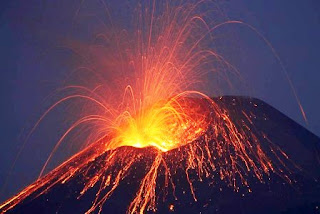 Volcanoes arranged by country and region.
 Volcanoes arranged by country and region.

