Showing posts with label ocean. Show all posts

Thursday, January 27, 2011

Volcanoes arranged by country and region.

Every volcano which has erupted in the past 10,000 years is listed, plus many ancient volcanoes
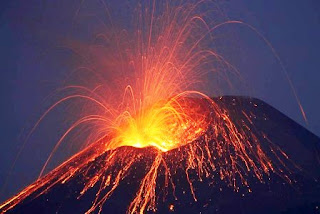
  Volcanoes arranged by country and region.
Afghanistan                  Ethiopia
Fiji
France
French Polynesia
Galapagos Islands
Georgia
Germany
Greece
Guatemala
Hawaii
Honduras
Iceland
India
Indian Ocean
Indonesia
Iran
Italy
Japan
Kamchatka
Kenya
Korea
Kurile Islands
Libya
Madagascar
Malaysia
Mali
Mariana Islands
Mexico
Mongolia
Myanmar
New Zealand
Nicaragua

Africa
Alaska
Algeria
Antarctica
Arctic Ocean
Argentina
Armenia
Asia
Atlantic Ocean
Australia
Azerbaijan
Azores
Bolivia
Burma
Cameroon
Canada
Canary Islands
Cape Verde
Caribbean
Chad
Chile
China
Colombia
Comoros
Congo DR
Costa Rica
Djibouti
Dominica
Ecuador
El Salvador
Equatorial Guinea
Eritrea
Niger
Nigeria
Norway
Pacific Ocean
Panama
Papua New Guinea
Peru
Philippines
Portugal
Red Sea
Reunion
Russia
Rwanda
Samoa
Sao Tome
Saudi Arabia
Solomon Islands
South Africa
South Sandwich Islands
Spain
Sudan
Syria
Taiwan
Tanzania
Tonga
Turkey
Uganda
United States
Vanuatu
Vietnam
Wallis and Futuna
Yemen

Thursday, January 13, 2011

Climate change in world natural disaster in world

Climate Change has likely intensified the monsoon rains that have triggered record floods in Australia’s Queensland state, scientists said on Wednesday, with several months of heavy rain and storms still to come.
But while scientists say a warmer world is predicted to lead to more intense droughts and floods, it wasn’t yet possible to say if climate change would trigger stronger La Nina and El Nino weather patterns that can cause weather chaos across the globe.
“I think people will end up concluding that at least some of the intensity of the monsoon in Queensland can be attributed to climate change,” said Matthew England of the Climate Change Research Centre at the University of New South Wales in Sydney.

The Queensland floods have killed 16 people since the downpour started last month, inundating towns, crippling coal mining and are now swamping the state’s main city of Brisbane.
The rains have been blamed on one of the strongest La Nina patterns ever recorded. La Nina is a cooling of ocean temperatures in the east and central Pacific, which usually leads to more rain over much of Australia, Indonesia and other parts of Southeast Asia.
This is because the phenomena leads to stronger easterly winds in the tropics that pile up warm water in the western Pacific and around Australia. Indonesia said on Wednesday it expected prolonged rains until June.
Weather Switch
The Pacific has historically switched between La Nina phases and El Ninos, which have the opposite impact by triggering droughts in Australia and Southeast Asia.

“The first thing we can say with La Nina and El Nino is it is now happening in a hotter world,” he told Reuters, adding that meant more evaporation from land and oceans, more moisture in the atmosphere and stronger weather patterns.
“So the El Nino droughts would be expected to be exacerbated and also La Nina floods because rainfall would be exacerbated,” he said, though adding it would be some years before any climate change impact on both phenomena might become clear.
He said the current La Nina was different because of the warmest ocean temperatures on record around Australia and record humidity in eastern Australia over the past 12 months.
Prominent US climate scientist Kevin Trenberth said the floods and the intense La Nina were a combination of factors.
He pointed to high ocean temperatures in the Indian Ocean near Indonesia early last year as well as the rapid onset of La Nina after the last El Nino ended in May.

He said a portion, about 0.5C, of the ocean temperatures around northern Australia, which are more than 1.5C above pre-1970 levels, could be attributed to global warming.
“The extra water vapor fuels the monsoon and thus alters the winds and the monsoon itself and so this likely increases the rainfall further,” said Trenberth, head of the Climate Analysis Section at the National Center for Atmospheric Research in        Boulder, Colorado.
“So it is easy to argue that 1 degree Celsius sea surface temperature anomalies give 10 to 15 percent increase in rainfall,” he added.
Some scientists said it was still too soon to draw a definite climate change link to the floods.
“It’s a natural phenomenon. We have no strong reason at the moment for saying this La Nina is any stronger than it would be even without humans,” said Neville Nicholls of Monash University in Melbourne and president of the Australian Meteorological and Oceanographic Society.
But he said global atmospheric warming of about 0.75C over the past half century had to be having some impact.
“It has to be affecting the climate, regionally and globally. It has to be affecting things like La Nina. But can you find a credible argument which says it’s made it worse? I can’t at the moment.”